There are few things more exciting than welcoming a new little one to your family. In some cases, that joy is tempered by the reality of something going wrong during labour and delivery. This can include Hypoxic Ischemic Encephalopathy, or HIE.
HIE is damage to the brain that occurs due to oxygen deprivation and limited blood flow during the birthing process. It can have a variety of causes, including medical negligence during labour and delivery. Even mild HIE can cause disabilities, including conditions such as cerebral palsy (CP).
If your baby has been diagnosed with a birth injury related to HIE, you may be able to file a lawsuit against the at-fault doctor, nurses, and other healthcare professionals. Reach out to BILA today to schedule a free consultation with a birth injury lawyer in your province.
What Is HIE?

During pregnancy and through birth, a fetus receives necessary oxygen and nutrients from the mother through the umbilical cord. If the umbilical cord is compromised in some way, the fetus can suffer an irreversible neurological injury due to a lack of oxygenated blood. Hypoxia, or low oxygen, can result in damage to the brain tissue and cause long-term disabilities.
HIE is typically diagnosed shortly after birth. The medical team will perform a wellness assessment to determine a newborn’s Apgar score. This test rates an infant’s breathing effort, heart rate, muscle tone, reflexes, and skin color on a scale of 0 to 2. A score of 7, 8, or 9 is considered normal.
Any score lower than 7 may indicate that a newborn needs medical intervention. If a baby shows signs of HIE, such as floppy or overly tense muscles, difficulty feeding, a weak cry, and a pale, blue, or gray skin tone, then they will need immediate treatment. The standard treatment for HIE is therapeutic hypothermia, or whole body cooling, to protect the brain from further injury. Other interventions, such as EEG monitoring for seizures, anti-seizure medications, and supportive oxygen, are also common.
There is no cure for HIE. Instead, the focus is on preventing additional brain damage. If a child is diagnosed with a birth injury related to HIE, then they may require additional support such as physical or occupational therapy, speech therapy, assistive devices for vision and/or hearing, and early intervention programs.
Types of HIE
HIE is classified into three separate stages. These stages are based on a system developed in 1976 by Sarnat and Sarnat. These stages convey the severity of the brain damage and the symptoms that a child has at that point in time. In addition, the staging gives some information regarding prognosis which is the symptoms the child will likely experience as they grow and develop. The prognosis based on the following factors:
- The amount of time that a baby was deprived of oxygen;
- The baby’s birth weight and overall health at delivery;
- How quickly the baby received medical treatment (cooling therapy) and how effective the treatment was.
If your baby is diagnosed with HIE, it will be graded into one of these three stages.
Stage 1: Mild HIE
Hypoxic-Ischemic Encephalopathy is considered mild when the oxygen deprivation during labour and delivery was minimal. On assessment, the baby will exhibit the following signs:
- Consciousness: hyperalert
- Activity: normal
- Neuromuscular control (muscle tone, posture, stretch reflexes): normal muscle tone, with mild distal flexion and overactive stretch reflexes
- Primitive reflexes (suck, startle, and tonic neck): weak sucking, strong startle response, and slight tonic neck
- Autonomic function (pupils and heart rate): normal pupils and tachycardic heart rate
- Seizures: none
With mild HIE, a baby will appear stiff and hyperalert. The baby may have brisk reflexes to stimulus or may seem floppy. They may also be overly fussy and irritable, with difficulty feeding and sleeping.
Stage 1/mild HIE will typically resolve itself within 24 hours or a few days, usually with minimal long-term effects. The medical team should still carefully observe the infant and intervene when necessary. Fewer than 5% of babies with mild HIE will have a severe handicap.
Stage 2: Moderate HIE
- Consciousness: lethargic or obtunded
- Activity: decreased
- Neuromuscular control (muscle tone, posture, stretch reflexes): mild hypotonia with strong distal flexion and overactive stretch reflexes
- Primitive reflexes (suck, startle, and tonic neck): weak or absent suck reflex, weak or incomplete startle response, and a strong tonic neck
- Autonomic function (pupils and heart rate): miosis (pinpoint pupils) and bradycardic heart rate
- Seizures: common
In moderate HIE, a baby will have significant muscle weakness, lethargy, and limited reflexes in response to stimuli. They may also have breathing difficulties, including apnea. Infants with moderate HIE may have feeble cries, a disinterest in sucking, and excessive irritability. They may also have difficulty clapping or grasping with their hands.
At this stage, hypothermia therapy should be administered within the first 6 hours after birth. A baby with moderate HIE should be closely monitored, and the medical team should intervene when necessary. Treating physicians should also order an MRI to determine the extent of damage to the brain. 25 to 75% of infants with moderate HIE will develop a severe handicap or pass away early in life.
Stage 3: Severe HIE
- Consciousness: stupor or coma
- Activity: absent
- Neuromuscular control (muscle tone, posture, stretch reflexes): flaccid muscle tone, decerebration (abnormal posturing with extended arms and legs), and lower or nonexistent stretch reflexes
- Primitive reflexes (suck, startle, and tonic neck): absent
- Autonomic function (pupils and heart rate): unequal pupils and variable heart rate
- Seizures: common and treatment-resistant
Severe HIE is life-threatening. A baby with stage 3 HIE will be in a coma-like stupor, unresponsive to physical stimuli. They will generally lack neonatal reflexes and have poor muscle tone. Severe HIE is also associated with serious breathing problems, fixed or dilated pupils that do not respond to stimulus, fluctuating blood pressure, and an irregular heart rate. Babies with severe HIE will also have progressively increasing seizures that do not respond to treatment.
At this stage, whole-body cooling should be administered immediately. Doctors should continue to monitor the infant’s symptoms to determine a plan of care and order diagnostic tests (such as MRIs) to assess the nature and extent of brain damage. While cooling therapy cannot reverse existing brain damage, it may be able to prevent further damage. 75% or more of infants with severe HIE will develop a severe handicap or pass away early in life.
Causes of HIE
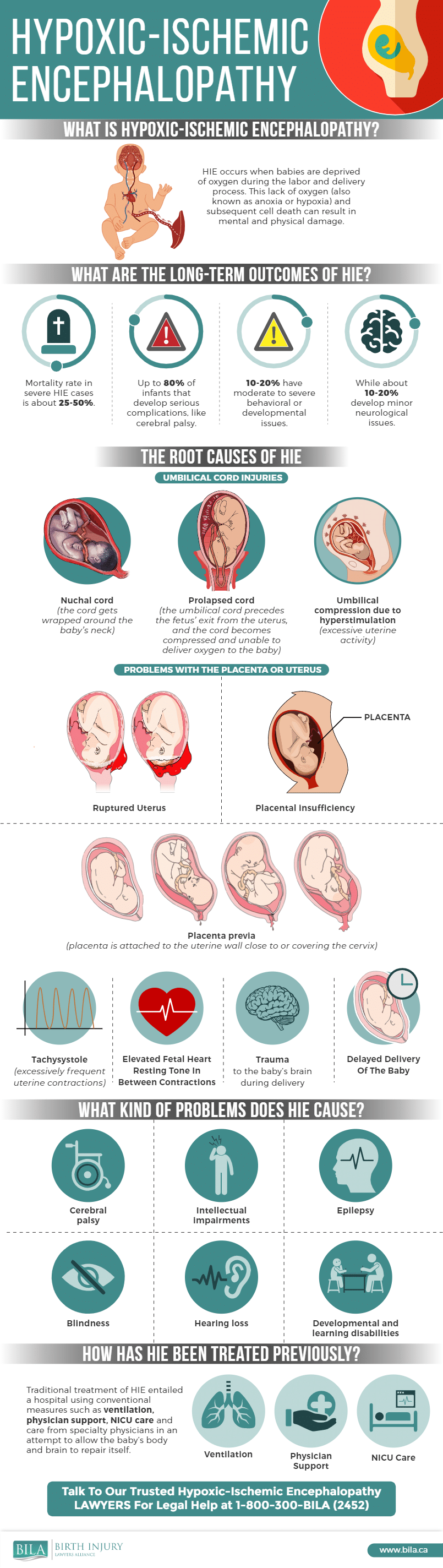
There are multiple potential causes of HIE. Prior to birth, a baby may suffer brain damage from oxygen deprivation due to an infection, high or low maternal blood pressure, abnormal development of the heart and/or lungs, and/or low maternal oxygen levels. During pregnancy, expectant mothers should be closely monitored for any potential complications that could cause HIE.
There are also several different causes of HIE during labour and delivery. This includes:
- Umbilical cord prolapse, where the umbilical cord drops before the fetus, compressing the cord;
- Nuchal cord, where the umbilical cord wraps around the neck of the fetus during the birthing process;
- Placental abruption, where the placenta separates from the uterus too early or fails to provide the necessary nutrients and oxygen to the fetus;
- Uterine rupture, where the uterus tears during the birthing process, causing maternal hemorrhage and reduced blood flow to the baby;
- Placenta previa, where the placenta blocks the cervix; and
- Assisted deliveries, such as through the use of forceps or a vacuum, can cause a brain injury during labour and delivery.
Another common cause of oxygen deprivation during labour and delivery is the compression of the umbilical cord during a long or difficult labour. During labour, contractions will reduce the blood flow through the umbilical cord, causing a reduction in the delivery of oxygen and nutrients to the fetus. When the contraction ends, the blood flow through the umbilical cord returns to normal.
In most cases, the fetus can tolerate the brief reduction in blood supply during a contraction and can recover during the resting phase between contractions. In some situations, however, this repeated reduction in the supply of oxygen and nutrients during contractions will exceed the fetus’s reserves. In particular, pre-term babies, twins or multiples, and those who are growth-restricted are less able to tolerate the reduction in blood supply that comes with contractions.
In addition, labour that is induced or boosted by oxytocin can cause contractions to be more frequent and longer in duration. This reduces the resting time between contractions, giving the fetus less time to recover.
During labour and delivery, doctors should carefully monitor fetal heart rate and other vital signs for symptoms of distress. Immediate intervention through an emergency cesarean section (c-section) is often necessary to prevent HIE. In many cases, HIE can be prevented with appropriate monitoring and medical intervention.
HIE is not always avoidable. However, proper monitoring and prompt intervention can significantly reduce the risk of oxygen deprivation. This includes both proper prenatal care as well as close monitoring of both the mother and fetus during labour and delivery. If a baby shows signs of fetal distress, then physicians and nurses should respond quickly to avoid or mitigate any brain damage to the infant.
Long-Term Impact of HIE
Any time that a baby is deprived of oxygen before, during, or after birth, there is a potential for brain damage. This oxygen deprivation can cause a lifelong impact on a baby, depending on the severity of the brain damage. Even mild forms of HIE can have severe consequences for both the infant and the family as a whole.
There are multiple birth injuries associated with HIE, including:
- Cerebral palsy, which is a collection of movement and posture disorders that can cause exaggerated reflexes, floppy or rigid limbs, atypical muscle tone, and involuntary movements, often as a result of brain damage during development or birth. Up to 80% of infants who are deprived of oxygen before or during birth may suffer from serious complications like cerebral palsy.
- Neurological, behavioral, and developmental issues, such as autism spectrum disorder, learning disabilities, and intellectual disabilities. The central nervous system is often significantly impacted by HIE. If your baby was deprived of oxygen during the birthing process and has signs of HIE, it is critical to follow up with neurology and ensure that they are closely monitored and receive appropriate pediatric interventions.
- Seizures are common among infants with HIE. These babies often show signs of subtle seizure activity shortly after birth and may have a higher risk of developing a seizure disorder later in life.
- Vision and/or hearing loss can also be caused by oxygen deprivation at birth. In some cases, visual and/or hearing disabilities are apparent at birth. In other cases, a baby is diagnosed when they are older.
Damage to the brain can cause a host of conditions and complications. If there was any indication that your infant was deprived of oxygen at birth, then additional medical monitoring and treatment are warranted. While the brain damage cannot be reversed, it is possible to limit the spread of brain damage and find the appropriate treatments for your child in the future.
Help for Families Affected by HIE
Oxygen deprivation during birth is associated with several serious birth injuries, including cerebral palsy. Kids who have been diagnosed with HIE may suffer lifelong disabilities. If your family is dealing with a HIE diagnosis, we are here for you.
The Birth Injury Lawyers Alliance (BILA) is a collective of experienced birth injury lawyers across Canada who are dedicated to advocating for families whose lives have been affected by birth injuries. If your baby has HIE or another birth injury, we are here for you. Call us at 1-800-300-2452 or fill out our online contact form to talk to an experienced birth injury lawyer in your province.

- Common Problems in the NICU - March 13, 2024
- Financial Assistance for NICU Stay - June 2, 2022
- Most Common Signs of Fetal Distress in Babies - February 1, 2022
